

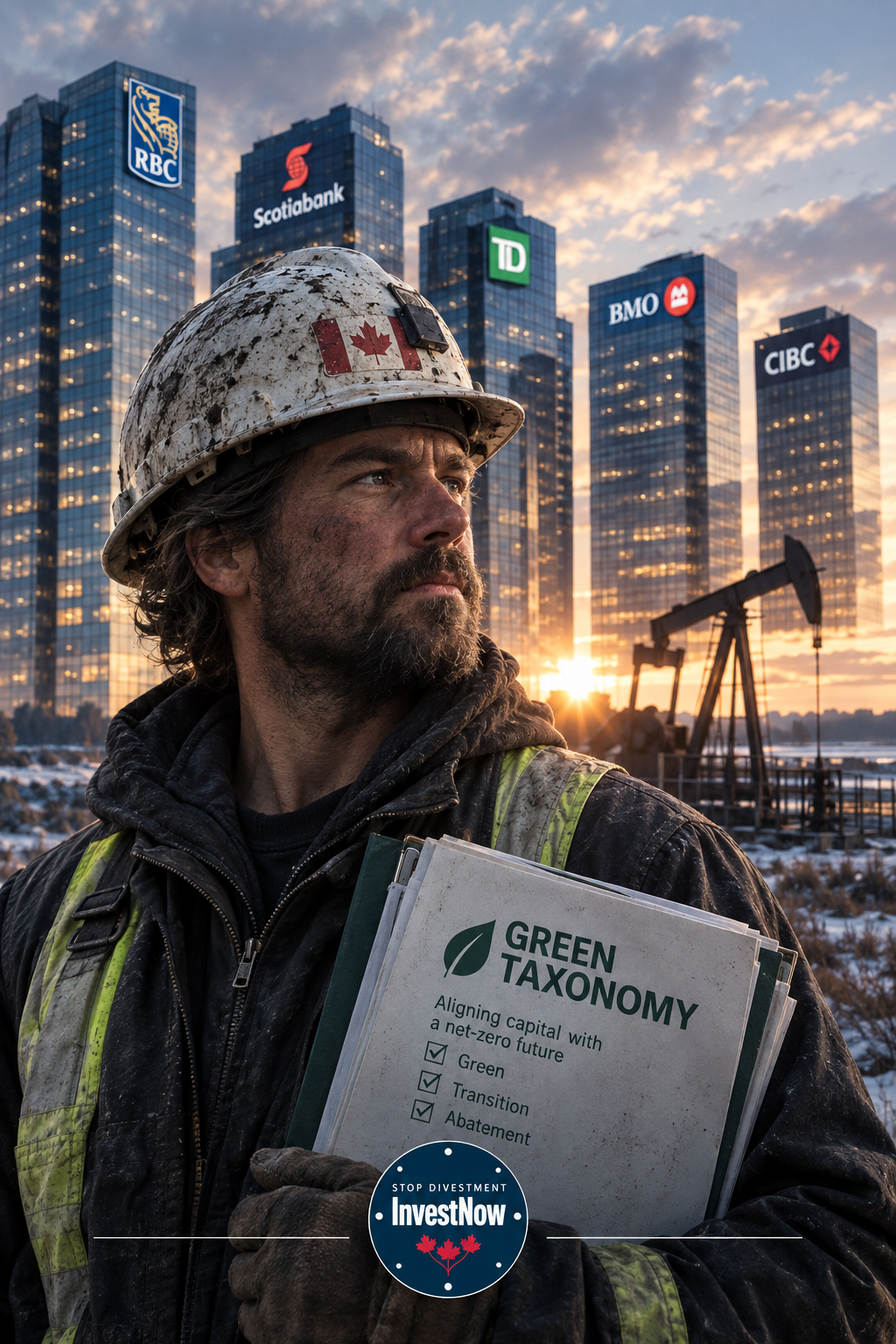
Dead? Not so fast — Ottawa’s ‘green taxonomy’ keeps the net-zero dream alive
This article originally appeared in the Western Standard.
After years of hearing that Canada achieving net-zero carbon emissions is a non-negotiable condition for the survival of the planet, it’s been a bit jarring to read so many articles in major publications proclaiming that “Net-Zero is dead” or even “Net-Zero is dead and gone.”For those of us who knew from the start that net-zero was an unachievable goal, and that the policy program designed to achieve it would be economically harmful, this is certainly a cause for celebration.
The top banks of Wall Street and Bay Street have all left Mark Carney and Michael Bloomberg’s pet project, the Glasgow Financial Alliance for Net Zero (GFANZ). Scotiabank has cancelled its commitment to net-zero by 2050, and the Royal Bank of Canada has ended its commitment to net-zero by 2030. The Canada Pension Plan Investment Board (CPPIB), one of the world’s largest pension funds, dropped its net-zero by 2050 target.
Furthermore, the activist group Investors for Paris Compliance (I4PC) has shuttered its doors after five years of actively trying to shut down Canada’s oil and gas sector. An agreement to build a new pipeline to the Pacific has been announced, and the Prime Minister is continually talking about the need to make Canada an Energy Superpower.
There’s even good news on the scientific side: the Intergovernmental Panel on Climate Change (IPCC) recently disavowed its climate worst-case scenario, known as RCP 8.5, making the projected outcomes of the major climate models less severe.
After years of pressure campaigns from activist groups promoting net-zero, energy transition, and decarbonization, recent activity suggests reality — economic and otherwise — is overpowering ideology.
As someone who has been in the trenches fighting against the ideological takeover of Canada’s financial markets, I admit to counting these developments as a “win.”
But anyone who needs a reminder that this fight is ongoing needs only read up on Canada’s Sustainable Finance Taxonomy, a proposal of the Business Future Pathways (“BFP”) and the Canadian Climate Institute (“CCI”), funded by the Government of Canada.
According to the Liberal Government’s press release announcing the Taxonomy initiative late last year, “The Government of Canada is committed to mobilizing public and private capital to promote investment in sustainability, as part of the transition to net-zero.”
The drafted Taxonomy (which refers to the practice of grouping things based on shared traits or similar qualities) proposes criteria to rank economic activities such as “green,” “transition,” or “abatement.”
In other words, the federal government is trying to steer investment and capital away from Canada’s traditional resource sectors and into businesses that are aligned with the objectives of the Paris Agreement and Canada’s legislated Net-Zero by 2050 commitments. If a company does not fall under one of the acceptable taxonomy categories, it will be hard-pressed to receive funding or investment capital from banks, insurance companies, public pension plans, and other institutional investors.
This concept is straight out of Mark Carney’s playbook, from the activist phase of his career, of aligning the global financial systems and financing with climate commitments by restricting oil and gas companies’ access to capital, and investing instead in companies that would help the transition to the “net-zero world of the future.”
Two years ago, in his capacity as an executive and climate investing leader as Chair of Brookfield Asset Management, Mark Carney testified before a Senate committee in full support of Bill S-243, Senator Rosa Galvez’s Climate-Aligned Finance Act (CAFA). It was designed to make it nearly impossible for financial institutions to invest in or lend to oil and gas companies.
Though that version of CAFA died on the order paper in January, Senator Galvez has reintroduced it. If passed, CAFA 2.0 would bring Canada another step closer to aligning our financial system with climate action.
Not surprisingly, Senator Galvez submitted a supportive response to BFP’s request for public comment on the Sustainable Finance Taxonomy: Methodology Report Draft. Senator Galvez writes, “The overarching objective of the taxonomy is to align Canada’s financial system with Canada’s climate commitments under the Paris Agreement and the Canadian Net-Zero Emissions Accountability Act.” The government-funded BPA and CCI, and Senator Galvez, are doing their part to align Canadian financial institutions with ideological climate goals.
And so, the fight against ideological banking and finance continues. It is ironic that, while Mark Carney and his Liberal Government have been promoting Canada as an energy superpower, they have at the same time been drafting plans — like the Taxonomy — to facilitate the restriction of capital to Canada’s oil and gas industry and other resources and industrial sectors. These goals are mutually contradictory, and if he’s made to choose between them, the Prime Minister will, unfortunately, choose ideology.
Gina Pappano is executive director of InvestNow.
Read Article 